
Why Every Business Will Need a Company Brain Before AI Can Actually Work
Y Combinator calls it a company brain. 360 Automation AI named it Business Context Engineering and shipped it first. The foundation every AI investment is built on.

TL;DR
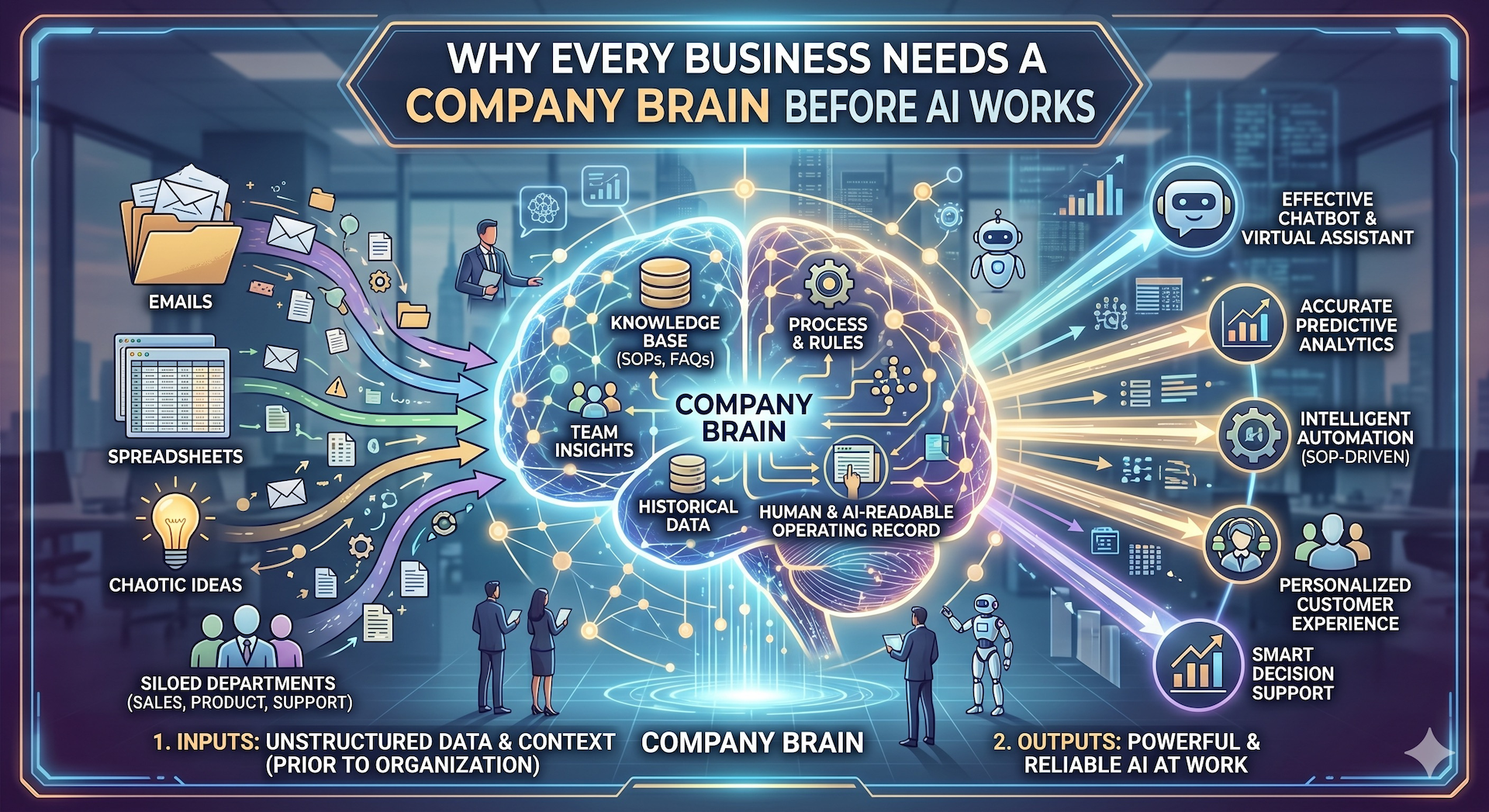
A "company brain" (the term Y Combinator uses, and what 360 Automation AI builds as Business Context Engineering) is a structured, machine-readable foundation that captures everything an AI system needs to know about a specific business, so any AI tool can operate with the depth of an experienced employee on day one.
- The blocker to AI is context, not capability. Modern AI models only know what you tell them. Without structured context, every AI interaction starts from zero.
- It is not search and not a chatbot over documents. It is a living map of how a business actually works: how it prices, how it handles exceptions, how it serves customers.
- It combines three things: a structured knowledge base, a connected software stack via Model Context Protocol (MCP), and a context layer any current or future AI tool can read.
- It is upstream infrastructure. AI agents, chatbots, voice agents, strategic AI roadmaps, and AI search experience all plug into it and perform better because of it.
- 360 Automation AI delivers it for Kansas City SMBs as Agent-Ready Infrastructure, with fixed scope and fixed pricing starting at $3,497, in two to four weeks.
Y Combinator recently published a Request for Startups it called "Company Brain." Its argument: the blocker to AI automation is no longer the models, which got good fast. The blocker is domain knowledge, the know-how scattered across people's heads, old email, Slack threads, support tickets, and databases. Every company, YC argued, will need a new primitive that pulls that knowledge out, structures it, keeps it current, and turns it into an executable foundation that AI can actually use.
That is the exact discipline 360 Automation AI has been delivering to Kansas City businesses. We call it Business Context Engineering, and we ship it as a productized service named Agent-Ready Infrastructure, an approach we had already proven in production before YC formally identified it as one of the next major tech frontiers.
This article explains what that foundation is, why every AI investment underdelivers without it, and why every service and every monthly plan we offer is built on top of it.
What Is Business Context Engineering?
Business Context Engineering is the structured discipline of capturing, organizing, and connecting everything an AI system needs to know about a specific business so that any AI tool can operate with the depth of an experienced employee on day one. It combines three things:
- Knowledge architecture: what the business knows, surfaced from documents, recordings, and the knowledge that lives in people's heads.
- Context structuring: how that knowledge is formatted so AI tools can consume it accurately.
- Model Context Protocol connectivity: how that knowledge is read by the software tools the business already uses.
Without this foundation, every AI investment starts from zero. The model has no idea what your business sells, who your customers are, or how you actually operate, so it produces generic output that could apply to any company. With the foundation in place, every AI investment compounds: each tool reads from the same structured source of truth, and the context only gets richer as the business evolves.
The compounding-knowledge-base pattern at the heart of this was first made popular by Andrej Karpathy, one of the most respected voices in AI. His insight is that most businesses use AI in a way that rediscovers their knowledge from scratch on every query, when the better approach is to compile that knowledge once into a persistent, structured foundation. 360 Automation AI productized that pattern for Kansas City SMBs, added MCP connectivity, and refined it through every engagement.
Why Do Most AI Investments Underdeliver?
Most AI investments underdeliver because the AI has no context about the specific business, not because the AI is weak. Every business owner has the same story:
- A chatbot that did not know their pricing.
- A ChatGPT test that returned generic answers any company could have written.
- An AI assistant that hallucinated facts about their own business.
- Tools that do not talk to each other, so context gets copy-pasted into prompts by hand.
The problem is structural. Modern AI tools only know what you tell them in the moment. Without a structured foundation, teams end up copy-pasting context into prompts, tools do not talk to each other, and the AI performs at a fraction of its potential. This is the precise failure mode the Y Combinator brief describes: knowledge that exists in the business but is scattered, unstructured, and unreadable by machines.
The fix is to do the context work first, as its own deliverable, before deploying any AI tool on top of it. That sequencing is the whole point. You build the foundation once, and everything you add afterward inherits it.
What Does Agent-Ready Infrastructure Actually Deliver?
Agent-Ready Infrastructure is Business Context Engineering delivered as one productized engagement, and it produces three concrete things:
- A structured knowledge base. We gather everything an AI needs to know about the business, from products and pricing to brand voice and decision history, captured from documents, spreadsheets, scanned files, and recorded audio or video, then organized into a single machine-readable foundation any current or future AI tool can read instantly.
- A connected software stack. We wire existing platforms (CRM, email, scheduling, accounting, marketing tools) into a unified context layer using Model Context Protocol, the emerging standard for connecting AI to business systems, so every connected tool draws from the same source of truth.
- A working demonstration. Before handoff, we sit down with the client and query the infrastructure live, so they watch ChatGPT, Claude, or any AI tool of their choice pull accurate, contextual information about their business in real time.
This is work that used to be buried inside $50,000-plus enterprise consulting engagements. 360 Automation AI productized it for Kansas City SMBs with fixed scope and fixed pricing.
How Is This Different From Search or a Chatbot?
A company brain is different from search and from a document chatbot because it captures how a business operates, not just what its documents say. Y Combinator made this distinction explicit, and so does 360 Automation AI's service.
The difference comes down to what each one captures:
- Company-wide search retrieves documents that match a query.
- A document chatbot answers questions about whatever files you point it at.
- Business Context Engineering produces a living map of how the business actually works: how refunds get handled, how pricing exceptions are decided, how a specific process runs end to end.
The first two treat the business as a pile of text to be queried. The third captures operational structure, which is what lets an AI tool act safely and consistently, not just retrieve and summarize.
The practical test is simple. Ask a document chatbot "what is our refund policy" and it finds the paragraph. Ask a properly engineered context layer the same question and the connected AI can apply the policy to a specific customer, check the connected system, and take or recommend the next action, because it understands the process, not just the text.
How Does 360 Automation AI Build It?
360 Automation AI builds Agent-Ready Infrastructure through a five-phase methodology called ADAPT, applied through the lens of Business Context Engineering. Each engagement follows the same sequence, scaled to the build tier.
The five phases:
- Analyze. Sit down with the team to understand how the business actually runs and what AI needs to know to be useful.
- Design. Architect a knowledge structure that matches how the business operates and how AI consumes context, not a generic template.
- Automate. Build the knowledge base, document the processes, and connect the software platforms through MCP so every tool draws from the same intelligence.
- Perfect. Test the infrastructure with real AI queries, refine based on what the AI actually retrieves, and tune until it performs.
- Transfer. Hand off complete ownership, train the team on maintenance, and document everything so the infrastructure belongs to the client forever.
The deliverable is the client's to keep. It lives on infrastructure they control and works with any AI tool they choose, now or later. There is no vendor lock-in.
Why Is This the Foundation Everything Else Is Built On?
Agent-Ready Infrastructure is upstream infrastructure, which means every other service and every monthly plan 360 Automation AI offers is built on top of it. This is not a positioning claim. It is how the engagements are actually structured.
Every service plugs into it
The context layer feeds four downstream motions:
- The Fractional AI Officer service builds your AI roadmap on the structured context, so every strategic recommendation is grounded in how your business actually operates and competes, instead of starting from zero. The roadmap decides what to build; the infrastructure is what it reads to decide.
- Digital AI employees deployed in the Department, Workforce, or Operations tiers draw their context directly from the knowledge base and operate against the already-connected MCP stack, so they perform better from day one and the client does not pay to build context twice.
- AI Search Optimization publishes the right slices of unique business and brand context into the formats that ChatGPT, Perplexity, Claude, and Google AI Overviews read, and because the gathering and structuring work is already done, those clients skip the discovery phase.
- Any new AI tool, whether a chatbot, a custom agent, or something that does not exist yet, plugs into infrastructure that already understands the business.
Every monthly AI plan we offer starts with it
On the plans side, the dependency is even more explicit. Every monthly plan begins with an Agent-Ready Infrastructure onboarding build before anything is deployed on top of it. Each plan's onboarding is an Agent-Ready Infrastructure build of increasing depth, followed by the workforce and services that run on it.
Foundation plan
- The foundation: ARI Starter Build, 2 weeks, up to 30 context files, 5 platforms connected via MCP, 3 processes documented.
- What runs on top of it: one fully managed AI agent, continuous monitoring, and a monthly strategy call.
Scale plan
- The foundation: ARI Professional Build, 3 weeks, up to 75 context files, 7 platforms, 7 processes.
- What runs on top of it: up to 5 AI agents, the AEO/GEO Pro package, and your choice of a chatbot or Voice AI.
Enterprise plan
- The foundation: ARI Enterprise Build, 4 weeks, up to 150 context files, 12 platforms, 12 processes, plus custom MCP servers.
- What runs on top of it: an AI workforce with subagent orchestration, AEO/GEO Pro, both chatbot and Voice AI, and founder-level strategy with a roadmap.
The pattern is the same at every tier: build the brain first, then deploy the workforce and the visibility layer on it. You invest in the infrastructure, and every AI service bought after it gets cheaper, faster, and more effective because the context already exists.
Y Combinator Brief Validated This Category
Y Combinator's "Company Brain" Request for Startups validates the category because it independently describes, almost point for point, the discipline 360 Automation AI already named and shipped. When the most influential startup accelerator declares a category worth funding, it is signaling that the market need is real and durable.
The overlap is close to exact:
- The blocker is scattered domain knowledge. YC says it; the Agent-Ready Infrastructure service opens with the same diagnosis.
- The system must pull knowledge out, structure it, and keep it current. Those map directly onto the knowledge base, context architecture, and continuous-updating elements of Business Context Engineering.
- It is not search and not a document chatbot. YC is explicit about this, and so is 360 Automation AI.
- The output is the layer between raw data and reliable AI. YC calls it the missing layer; 360 Automation AI calls it upstream infrastructure that everything plugs into.
There is one honest difference worth naming. The YC framing imagines a venture-scale, largely automated product that wires itself into any company. 360 Automation AI delivers the same outcome today as an expert-led, MCP-connected, fixed-price engagement built specifically for SMBs, with a human curation step that a self-serve product cannot match yet. The category is the same.
Frequently Asked Questions
What is a company brain in AI?
A company brain is a structured, machine-readable foundation that captures everything an AI system needs to know about a specific business, so any AI tool can operate with the depth of an experienced employee. 360 Automation AI builds this as Business Context Engineering, delivered as the Agent-Ready Infrastructure service.
Do I have to build this before deploying AI agents?
Yes. The context layer is upstream infrastructure, so 360 Automation AI builds it first on every monthly plan or service. Digital employees, chatbots, voice agents, strategic AI roadmap, and answer-engine visibility all draw from it, which is why deployment is faster and the agents perform better when the foundation already exists.
Is Business Context Engineering the same as the Y Combinator company brain idea?
They describe the same category. Y Combinator's "Company Brain" Request for Startups (April 2026) calls for a system that pulls scattered company knowledge into a structured, current foundation for AI. Business Context Engineering is that discipline, already named and delivered in production by 360 Automation AI for Kansas City businesses.
Who owns the infrastructure after it is built?
The client owns it completely. The knowledge base lives on infrastructure the client controls, works with any AI tool they choose, and comes with full documentation and team training at handoff. There is no vendor lock-in.
Where to Start
The foundation begins with a conversation. In 30 minutes, 360 Automation AI can tell a Kansas City business exactly what its Agent-Ready Infrastructure should look like, which build tier fits, and what the first 30 days after handoff could realistically achieve.
The category Y Combinator is now funding nationally is already a productized, fixed-price service in Kansas City. Build the brain once, and every AI investment after it compounds.
Contact us or visit the Agent-Ready Infrastructure service page to start. The consultation is free, the recommendations are honest, and the decision is yours.
Agent-Ready Infrastructure, powered by Business Context Engineering.