
MCP Connectors in 2026: What They Are and How They Work
An MCP connector is a standardized bridge that gives AI assistants like ChatGPT and Claude two capabilities they previously lacked: real-time context from your business systems and the ability to take action inside those systems. Without connectors, AI is a conversation. With them, AI becomes an operator. This is the shift that turned 2025 and early 2026 into the most consequential period in business AI since the launch of GPT-4.

Quick Answer
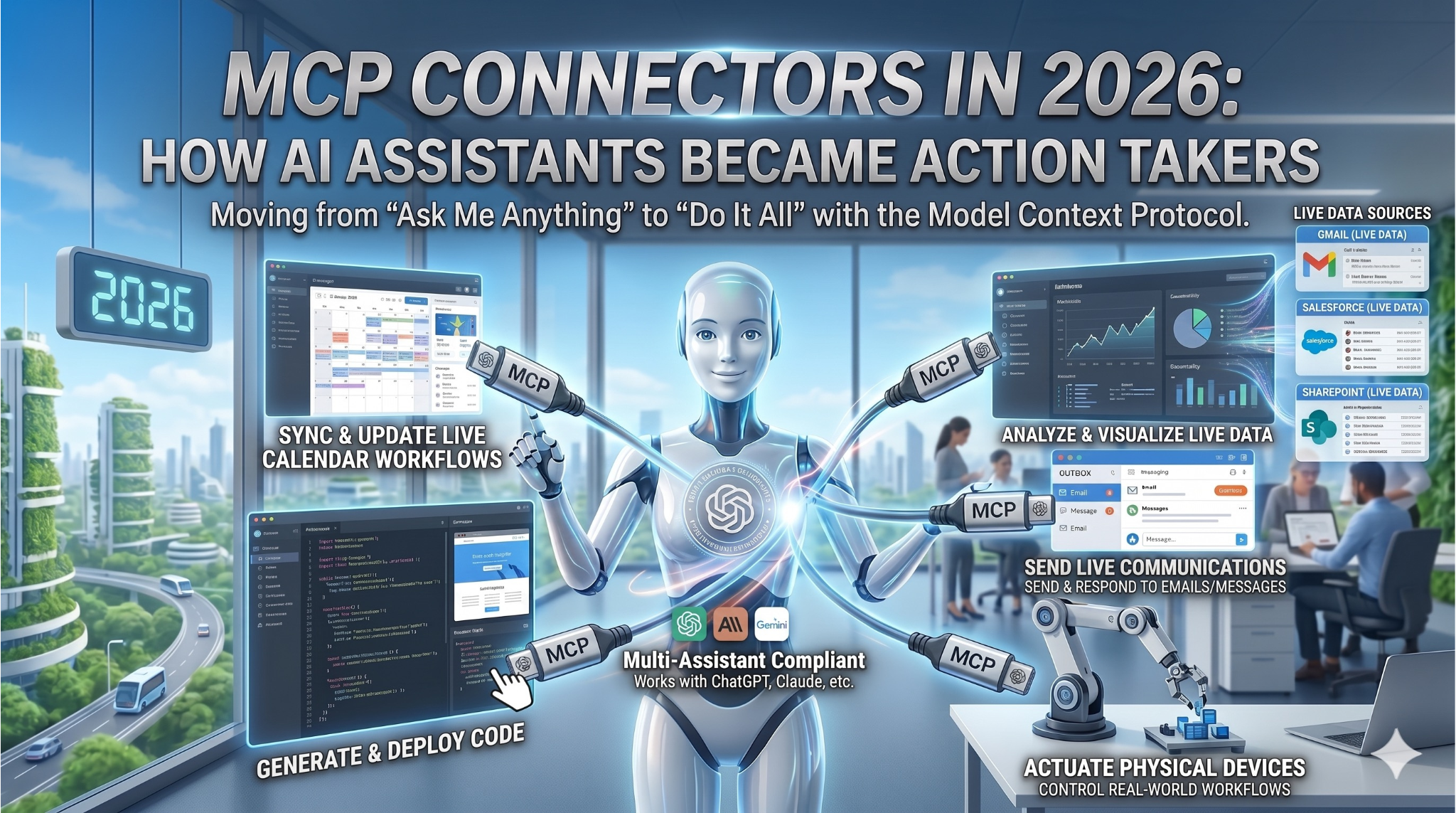
MCP connectors transform AI assistants in three core ways:
- Context access: Connectors let AI assistants read live data from tools like Gmail, Salesforce, Stripe, and SharePoint instead of relying only on training data or what you paste into chat.
- Direct action: AI assistants can write, update, send, and trigger workflows inside business systems instead of telling you what steps to take.
- Standardized integration: Built once, an MCP connector works with any compliant AI assistant, eliminating the custom integration work each tool used to require.
The result is that ChatGPT, Claude, and other AI assistants moved from text generators to context-aware agents that complete actual work in actual systems.
From Conversation to Action: The Shift That Changed Business AI
For most of 2023 and 2024, AI assistants had a fundamental limitation that rarely got named clearly: they could talk about your business, but they could not see it or touch it. You could ask ChatGPT to draft a follow-up email to a sales prospect, but ChatGPT could not actually look at the prospect's record, the previous email thread, or the deal stage. You had to paste everything in.
That isolation defined the user experience. AI was eloquent and capable, but it lived in a sealed room. It could explain how to update a customer record. It could not update one.
The Model Context Protocol (MCP), released by Anthropic in November 2024 and now an open standard backed by OpenAI, Google DeepMind, Microsoft, and the Linux Foundation, changed the unit of work. Anthropic donated MCP to the Linux Foundation's new Agentic AI Foundation in December 2025, with OpenAI and Block as co-founders and Google, Microsoft, AWS, Cloudflare, and Bloomberg as supporting members. The protocol stopped being one company's standard and became neutral infrastructure.
What MCP enabled was simple to describe and significant to experience: AI assistants gained both context and action through a standardized connection layer. The conversation became the work.
What Is an MCP Connector?
An MCP connector is a server that implements the Model Context Protocol to bridge an AI assistant and a specific tool, application, or data source. When you hear about an MCP connector for Salesforce or a Gmail MCP connector, it refers to a piece of software that exposes that system's capabilities to any compliant AI assistant in a standardized way.
Four terms get used interchangeably, and clarity helps:
- MCP: The open protocol itself, a standard for how AI assistants and external tools communicate.
- MCP server: The technical implementation that exposes a tool or data source. The Gmail MCP server makes Gmail accessible to AI assistants.
- MCP connector: The market-facing term for an MCP server, especially when packaged for end users. Functionally identical to MCP server.
- MCP client: The AI assistant or application doing the connecting. Claude, ChatGPT, Cursor, and Microsoft Copilot are MCP clients.
The architecture is intentionally similar to how USB-C works. MCP turns the n by m problem (every LLM app times every tool) into n plus m. Build a server once; any compliant client can use it. This is why adoption accelerated so quickly through 2025 and into 2026.
The Two Things AI Was Missing, and How MCP Provided Both
The phrase agentic AI gets used loosely. Stripped of the hype, it describes a specific capability shift: AI systems that have context and can take action. MCP connectors are how that shift became practical for production use.
Context: Knowing What Is Actually Happening in Your Business
AI assistants are trained on the public internet, not on your business. They know how CRMs work in general; they do not know what is in yours. Before MCP, the only way to give an AI assistant context about your specific situation was to paste it manually, often with privacy and accuracy compromises.
MCP connectors give AI assistants structured, real-time access to the systems where work actually happens. A connector for HubSpot lets the assistant pull a specific contact's deal history. A connector for Stripe lets it look at this month's actual MRR. A connector for SharePoint lets it locate the actual document the team has been editing.
The shift is from generic to specific. From training data to live data. From AI knowing about your industry to AI knowing about your business.
Action: AI Doing the Work, Not Just Describing It
The second capability is the one that genuinely changes what AI is for. Pre-MCP, AI assistants produced text. Post-MCP, they produce outcomes.
A Gmail MCP connector does not just help draft replies. It lets the assistant read the inbox, draft, and send. A Stripe connector does not just discuss pricing strategy. It lets the assistant pull live revenue data, run analysis on real numbers, and surface anomalies. A Notion or Drive connector does not just suggest documentation structure. It lets the assistant find, read, summarize, and update actual documents.
Context without action is research. Action without context is automation. The combination of both is what makes the current generation of AI feel different from the previous one. It is no longer a chatbot. It is an operator with situational awareness.
The MCP Connector Landscape in 2026
The connector ecosystem has stratified into four distinct categories, each serving different needs and audiences. Understanding the landscape is the first step in mapping where MCP fits in any business stack.
First-Party MCP Connectors
Built by the platform itself, first-party connectors offer the deepest integration. GitHub, Stripe, Slack, HubSpot, Shopify, Notion, and Linear all maintain official MCP servers. Companies including GitHub, Block, Apollo, Replit, Sourcegraph, Linear, Zapier, and many others have integrated MCP into their platforms.
These connectors are vendor-maintained, security-vetted, and tightly coupled to the underlying product. They are the recommended starting point when the platform you need has shipped one.
Aggregator MCP Connectors
For the long tail of business tools that do not yet have first-party MCP servers, aggregator connectors solve coverage. Zapier MCP is a remote MCP server that gives AI direct access to 9,000+ apps and 40,000+ actions through a single connection. Composio takes a similar approach, with hosted MCP servers for thousands of services.
The tradeoff is depth versus breadth. Aggregator connectors get you connected to almost anything quickly, but the integration is typically narrower than what a first-party connector provides. They are well-suited to broad workflow automation across many tools.
Custom MCP Connectors
Many businesses run on systems no aggregator covers: internal databases, proprietary platforms, legacy ERPs, industry-specific software. Custom MCP connectors are built to expose these systems to AI assistants in a controlled, secure way.
This category is where AI consultancies and in-house engineering teams do the most work. The investment is higher than connecting via an aggregator, but the integration is purpose-built for the actual workflow, with appropriate authentication, scoping, and data governance.
Browser-Based Connectors (WebMCP)
WebMCP is a separate, complementary capability worth understanding. WebMCP is currently available for prototyping to early preview program participants in Chrome 146 Canary as of February 2026. Rather than connecting AI assistants to backend systems, it lets websites expose structured tools directly to AI agents running in the browser.
WebMCP is not a replacement for MCP. The two address different needs: MCP is available on any platform at any time and handles core tasks; WebMCP is available only on a specific website and provides a high-fidelity way for browser-based agents to interact with what the user sees in their tab. WebMCP is early-stage technology, not yet a production tool for most businesses, but it signals where the connection layer is heading.
The Scale of MCP Adoption
The numbers explain why MCP connectors went from niche to mainstream in roughly eighteen months:
- MCP adoption hit 97 million monthly SDK downloads by March 2026, up from roughly 100,000 at launch in November 2024.
- An independent census from Nerq in Q1 2026 indexed 17,468 MCP servers across registries.
- Within eighteen months, MCP became one of the most widely adopted integration standards in the generative AI ecosystem, backed by the organizations building frontier models and the platforms enterprises depend on.
- In April 2026, the Agentic AI Foundation held the MCP Dev Summit North America in New York City, drawing approximately 1,200 attendees.
The point is not that MCP is popular. It is that the integration layer for AI has converged on a single open standard backed by every company that matters in the space. For businesses making AI investment decisions in 2026, this is the most important fact about the landscape: the question of which integration protocol to build on has been answered.
What AI Action-Taker Looks Like in Practice
Three illustrative scenarios show what changes when AI assistants get connectors:
A sales workflow with a CRM connector.
Without MCP, the assistant can draft a follow-up email if you describe the prospect. With an MCP connector to your CRM, the assistant can pull the contact record, review the last three interactions, draft a contextually accurate follow-up, and log it back to the contact's activity timeline. The work moves from your inbox to the system of record.
A finance workflow with a payments connector.
Without MCP, asking ChatGPT about your business's revenue produces generic guidance. With a Stripe MCP connector, the assistant can pull live MRR figures, identify churn anomalies, compare period-over-period performance, and surface the customer accounts driving each trend. The analysis is grounded in real numbers, not hypothetical ones.
A documentation workflow with a knowledge-base connector.
Without MCP, the assistant can suggest how to structure documentation. With a Notion or SharePoint MCP connector, the assistant can locate the actual document, read it in context, draft updates, and apply them. The work happens in the system, not in a chat window.
The pattern across all three is the same: the assistant stops describing the work and starts doing it.
What This Means for the AI Stack in 2026
The architecture of business AI has reorganized around a clear pattern. The model itself is increasingly commoditized. Differentiation now lives in the connection layer.
Three observations capture where the landscape sits:
- Connection depth is becoming the procurement question. When evaluating AI tools or platforms, the relevant questions are no longer about model quality alone. They are about which MCP connectors the system supports, how mature each connector is, and how governance and security are handled at the connector level.
- The stack mental model has replaced the tool mental model. Modern AI deployment is not a single product decision. It is a stack: model, connectors, data sources, and governance. Each layer matters, and connectors are the layer most often underestimated.
- Businesses without an MCP-aware strategy are leaving the action layer of AI on the table. Using AI assistants without connectors in 2026 is functionally similar to using the internet without a browser. The capability exists; the access layer is missing.
The shift from chatbot to action-taker is, at its core, a shift in what AI is for. The assistants got connected. The work got done.
Frequently Asked Questions
What is an MCP connector?
An MCP connector is a server that implements the Model Context Protocol to bridge an AI assistant and a specific tool or data source. It gives the assistant the ability to read context from that system and take actions inside it through a standardized interface that works with any compliant AI client.
How does MCP turn ChatGPT or Claude into an action-taker?
MCP gives AI assistants two capabilities they previously lacked: real-time access to your business data and the ability to perform actions inside your tools. Without MCP, the assistant can only generate text. With MCP connectors installed, the same assistant can read your inbox, query your CRM, update documents, run queries against your database, and trigger workflows in your business systems.
What is the difference between MCP and a traditional API?
A traditional API is a direct interface to a single service. MCP is an open protocol layer that standardizes how AI assistants discover and call tools across many services. MCP is owned by the ecosystem, not by any single vendor. Traditional APIs still exist underneath; MCP servers typically wrap APIs in a standardized way so AI assistants can use them without custom integration code.
Are MCP connectors secure?
Security depends on the connector implementation, the authentication method, and the host environment. The protocol supports OAuth 2.1 and scoped permissions, and most production connectors run with explicit user consent and per-tool allow lists. Independent security researchers have published findings on attack classes specific to MCP deployments, and enterprise governance frameworks designed before MCP reached adoption scale frequently do not yet describe MCP-specific controls. Like any new infrastructure layer, MCP connectors require thoughtful implementation, scoped permissions, and active governance.
What is the difference between MCP and WebMCP?
MCP is a server-side protocol for connecting AI assistants to backend tools and data, available on any platform at any time. WebMCP is a complementary browser-side standard that lets websites expose structured tools to AI agents running in the browser. WebMCP is currently available in early preview through Chrome 146 Canary as of February 2026. The two are designed to work together, not to replace one another.
Do I need a custom MCP connector or can I use an off-the-shelf one?
The answer depends on the system you are connecting to. Major platforms increasingly ship first-party MCP connectors (GitHub, Stripe, Slack, HubSpot, Shopify, Notion). Aggregator services like Zapier MCP cover thousands of additional applications through a single connection. Custom connectors are typically needed when the system in question is internal, proprietary, or specialized enough that no first-party or aggregator option exists.
Mapping Where MCP Fits in Your Stack
The MCP and connector landscape is now stable enough to make decisions on. The protocol has converged. The major platforms have adopted it. The connector ecosystem is broad enough that most common business tools are reachable, with first-party, aggregator, or custom paths available depending on the situation.
For Kansas City businesses and AI-aware teams nationally, the practical question in 2026 is no longer whether to use MCP. It is where MCP fits in the AI stack you are already building, and which connectors deliver the most leverage for the workflows you care about.
If you would like to map where MCP connectors fit in your business, including what to integrate first, which connectors to use, and how to think about governance, 360 Automation AI offers a complimentary 30-minute consultation to walk through your current AI stack and identify the highest-impact connection points.
Call (816) 705-2205 or email [email protected] to schedule your consultation.
360 Automation AI serves SMBs across the Kansas City metro area. Statistics and adoption data are sourced from primary references including Anthropic, Chrome for Developers, and in-house research.