
Why Kansas City Businesses Are Hiring Managed AI Agents Instead Of Building Them
Most AI tools hand you a platform and walk away. A managed AI agent service delivers a working digital employee, complete with infrastructure, integrations, and ongoing improvements, so your team never touches the technical layer. Here is why Kansas City businesses are choosing the managed model over building in-house, what a fully managed deployment actually includes, and how the economics compare to hiring traditional staff.

Last Updated: August 10 2026
TL;DR
A managed AI agent service runs your digital employees end-to-end so you never touch the technical layer:
- Fully managed infrastructure: All AI usage, model access, cloud computing, and integrations included in one flat monthly price. No API bills, no token counting, no surprise charges.
- Ready-to-work digital employees: Each agent arrives with its own email, access to your platforms, and a custom knowledge base built around your business. Day one is a working employee, not a setup ticket.
- Continuous operation and improvement: 24-hour monitoring with auto-recovery, weekly improvements, and 48-hour turnaround on standard change requests at no extra cost.
- Enterprise infrastructure, private by contract: Agents run on enterprise-grade AWS infrastructure, and privacy-centric workflows use language models under zero data retention agreements, so prompts and outputs are never stored after a request completes and never used for training.
- Local Kansas City partnership: On-site strategy sessions, MIT-Sloan certified leadership, and face-to-face accountability that remote consultants and SaaS vendors cannot match.
The result is a digital workforce your team can talk to like a coworker, not a tool your team has to maintain like another piece of software.
What Is A Managed AI Agent Service?
A managed AI agent service is one where a vendor builds, deploys, monitors, and continuously improves AI digital employees on your behalf for a flat monthly fee. A SaaS platform sells you a tool your team configures. A managed service delivers the working outcome and owns everything required to produce it.
Three things separate managed from self-serve:
- Single point of accountability. One vendor owns the fix. No finger-pointing between your CRM provider, your AI tool, and your IT contractor.
- Bundled cost structure. Infrastructure, model access, integrations, and labor sit inside one invoice. No metered API bill that surprises you the month a workflow gets popular.
- Operational ownership. The vendor runs the agent, not your team. Your staff keeps the judgment work; the agent takes the repetitive layer.
This mirrors the shift in IT a decade ago, when businesses stopped hiring server admins and started subscribing to managed cloud. In McKinsey's State of AI survey published November 2025, 88 percent of respondents said their organizations regularly use AI in at least one business function, up from 78 percent a year earlier. Adoption is no longer the differentiator. Getting measurable value from it is.
Why Are Kansas City Businesses Choosing Managed Over Building It Themselves?
What does the implementation gap actually cost?
Most AI projects fail in the engineering layer between buying a model and running a workflow without a human in the loop. Anthropic's engineering write-up on multi-agent systems, published June 2025, puts it directly: "When building AI agents, the last mile often becomes most of the journey."
For a Kansas City SMB, closing that gap means hiring for it:
- Senior AI engineer. Roughly $135,000 to $175,000 base in the KC metro, closer to $175,000 to $230,000 fully loaded.
- Platform integration specialist. Someone who owns the connections between the agent and your CRM, calendar, and accounting systems.
- On-call coverage. Someone reachable when an agent breaks at 9 p.m. on a Tuesday.
That is a permanent payroll line, not a one-time build cost. The math rarely works below 500 employees.
How does the cost compare to hiring a person?
A full-time administrative or coordinator hire in the Kansas City metro costs roughly $35,000 to $65,000 per year once salary, payroll taxes, benefits, software seats, and onboarding are included. The Bureau of Labor Statistics reports that benefits alone account for roughly 30 percent of total compensation in private industry, so the listed salary is never the real number.
A digital employee changes the shape of that cost:
- Runs continuously. No shift limits, no sick days, no holiday coverage gaps.
- Never loses context. Every conversation starts with the full history of the account.
- Costs a fraction of loaded headcount. Plans start at $2,497 per month with all infrastructure included.
Why do AI tools end up as shelfware?
The dominant failure in SMB AI adoption is not buying the wrong product, it is buying the right product and never operationalizing it. Software-only tools push the real work onto your team.
That work usually includes:
- Designing the workflows and deciding what the agent should and should not touch.
- Writing and tuning prompts as the business changes.
- Managing credentials across every connected platform.
- Monitoring outputs and catching failures before a customer does.
It falls to whoever is least busy, which is rarely the right person. Six months in, the tool is half-deployed and quietly cancelled.
What Does A Fully Managed AI Agents Deployment Include?
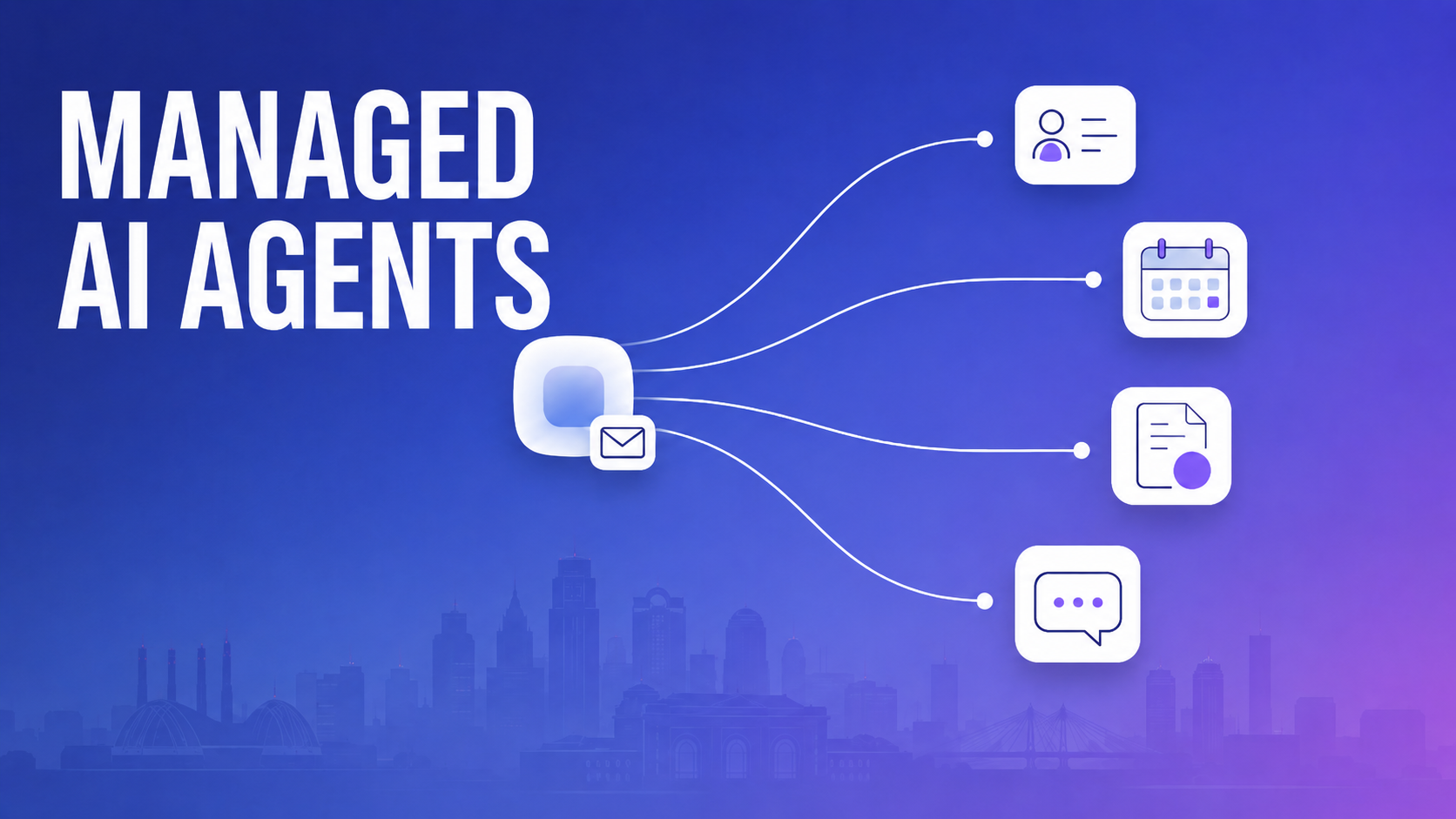
A complete managed deployment covers five layers your team never touches. The customer-facing surface stays simple: you talk to your digital employees, and the vendor handles everything underneath.
- Infrastructure. Cloud compute, model access, sandboxing, and runtime, including model selection and version upgrades. You never see a token count.
- Integration. Secure connections to your CRM, email, calendar, accounting, scheduling, and messaging platforms.
- Identity. Each agent gets its own email address, allowlisted platform access, and a defined scope of authority.
- Knowledge. A vendor-maintained knowledge base of your people, processes, clients, and brand voice, which grows as the agent learns.
- Operations. Continuous health monitoring with automatic recovery, weekly improvements, and 48-hour turnaround on standard change requests.
The integration layer is worth one note on durability. Most modern agent integrations run on the Model Context Protocol, donated in December 2025 to the Agentic AI Foundation, a directed fund under the Linux Foundation. Integrations built on an open standard outlast the proprietary connectors of the previous automation generation.
Where do the agents run, and how is your data protected?
360 Automation AI runs client digital employees on enterprise-grade AWS infrastructure, and privacy-centric workflows use LLMs under zero data retention agreements. Infrastructure is the layer buyers rarely ask about until an auditor or a large customer does.
What that means in practice:
- Enterprise-grade AWS hosting. The compute, network isolation, encryption, and access controls enterprise IT already accepts, without you procuring or maintaining any of it.
- Zero data retention agreements. A contractual commitment from the model provider that prompts and outputs are not retained after a request completes and are never used to train future models.
- Scoped access per agent. Separate credentials, sandboxed execution, and approval gates on sensitive write operations.
- A further step when required. Where a workflow cannot leave your own hardware, a fully self-hosted local model is available as a separate engagement.
The practical effect is that data handling becomes a contract term rather than a promise. For most Kansas City businesses, zero data retention on managed enterprise infrastructure is the right balance of capability, cost, and control.
How Do The Economics Compare?
The honest comparison across hiring, DIY tools, and a managed service comes down to three numbers: total cost, time to a working outcome, and operational burden on your team.
- Hire a coordinator: $35,000 to $65,000 per year fully loaded, productive in 60 to 90 days. You carry recruiting, onboarding, management, and turnover.
- Build it yourself with DIY AI tools: $3,000 to $40,000 in software plus internal labor, six to 12 months if it ships at all. Your team builds, integrates, monitors, and fixes.
- Engage a managed AI agent service: $30,000 to $90,000 per year depending on agent count, first agent live in one to four weeks. The vendor runs everything technical.
A managed service is not always the cheapest line item. It is consistently the lowest total cost of ownership once you count the labor spent stitching tools together, the opportunity cost of a six-month build, and the carrying cost of a deployment that quietly fails in month nine.
Two Gartner forecasts are worth reading together. Gartner projects that agentic AI will autonomously resolve 80 percent of common customer service issues without human intervention by 2029, driving a 30 percent reduction in operational costs. Gartner separately predicted in June 2025 that more than 40 percent of agentic AI projects will be cancelled by the end of 2027.
The distance between those two outcomes is an operating-model problem, not a technology problem. Businesses that reach the first one bought a working system. The cancellations land on the ones who asked their own team to become AI engineers.
How Long Until You See Results?
A Kansas City business starting from zero typically has its first digital employee live within one week and measurable ROI by month three. That pace is only possible because the vendor owns the work between milestones.
- Week 1. Your first digital employee is built, connected to your platforms, and live, with immediate time savings on the workflows it handles.
- Weeks 2 to 3. Workflows stabilize and your team shifts attention to higher-value work.
- Months 1 to 2. Additional agents come online if your plan supports them, and cross-agent coordination begins.
- Month 3 onward. Measurable ROI. Most clients recover 15 to 20 hours per week of team capacity and see fewer manual errors.
- Month 6 onward. Quarterly strategy reviews identify the next wave of automation as the portfolio grows.
Who Is The Managed Model Right For?
The managed model fits Kansas City SMBs with a real operational bottleneck, little or no internal AI team, and a preference for a working outcome over a flexible toolkit.
Best-fit industries based on current Kansas City client patterns:
- Marketing and creative agencies. Client onboarding, status updates, content distribution, reporting.
- Home services. HVAC, plumbing, electrical and roofing intake, scheduling, dispatch, follow-up, reviews.
- Manufacturing and distribution. Order processing, quote generation, supplier coordination, inventory updates.
- Wholesalers and suppliers. Account management, reorder workflows, customer communication.
- Real estate and insurance. Lead intake, document handling, client follow-up, scheduling.
- Retail and e-commerce. Order management, customer service, inventory coordination, review responses.
- Software and engineering teams. Code generation, bug triage, code review, deployment.
The poor fit is the business that wants to learn AI engineering as part of the engagement. A managed service is deliberately opaque on the technical layer. If your goal is internal capability rather than an outcome, a consulting engagement or a DIY tool serves you better.
Frequently Asked Questions
How is a managed AI agent service different from a SaaS automation tool?
A SaaS tool sells you a platform your team configures and operates. A managed service sells you the working outcome. With SaaS, your staff designs the workflows, writes the prompts, manages credentials, and fixes integrations when they break. With a managed service, the vendor owns all of it and you talk to your digital employees the way you would talk to a coworker.
Do I need internal technical staff to use a managed AI agent service?
No. The model is built so your team never touches infrastructure, models, integrations, or monitoring. The vendor handles the entire technical layer inside the flat monthly fee. Your only responsibilities are authorizing platform access during setup and giving the agent feedback as it learns your business.
How much does a managed AI agent cost compared to hiring an employee?
A Kansas City coordinator hire costs roughly $35,000 to $65,000 per year fully loaded, once salary, payroll taxes, benefits, software seats, and onboarding are counted. Managed AI agent plans start at $2,497 per month for a small deployment and run to $7,500 per month for a large digital workforce, with all infrastructure, integrations, monitoring, and ongoing improvements included.
Where do the AI agents actually run?
On enterprise-grade AWS infrastructure managed by the vendor, not on your servers and not on a consumer AI platform. That means enterprise-standard compute, network isolation, encryption, and access controls, with capacity scaling, patching, and model version upgrades handled for you. Businesses required to keep data on their own hardware can run a self-hosted local model instead, which is a separate engagement.
Is my business data safe with a managed AI agent?
Yes. Data transmission is encrypted, access is controlled through authentication, and agents only reach the systems you authorize, using scoped credentials per agent, sandboxed execution, and approval gates on sensitive write operations. For privacy-centric workflows the underlying language models run under zero data retention agreements, meaning prompts and outputs are not retained after a request completes and are never used to train future models.
Getting Started
Your team is spending hours each week on work a digital employee could handle. Kansas City businesses adopting managed AI workforces now gain the operational scale of much larger competitors at a fraction of the cost.
360 Automation AI builds and operates fully managed digital employees for Kansas City metro SMBs across marketing, home services, manufacturing, distribution, real estate, insurance, retail, and software. Every plan includes all infrastructure, integrations, monitoring, and ongoing improvements at one flat monthly price. See the Custom AI Agents service page for plan details.
Start with a free discovery call. It is a short conversation to establish whether this model fits your business and which level of engagement makes sense. Where a project needs proper scoping first, the Strategic AI Roadmap does that work for $3,000, credited back in full against your engagement within 30 days.
Book your free discovery call
You can also email [email protected] or call us at (816) 466-5846.
360 Automation AI is a Kansas City-based AI consultancy led by MIT Sloan-certified founder Shahzad Safri. Statistics are sourced from McKinsey's State of AI report (November 2025), U.S. Bureau of Labor Statistics Employer Costs for Employee Compensation (June 2026 release), Anthropic's published engineering research on multi-agent systems (June 2025), and Gartner's agentic AI forecasts (March and June 2025).