
AI Search Optimization in Kansas City: The Complete Guide to AEO, GEO, and Getting Found by AI
AI search optimization is the practice of structuring your website content, technical architecture, and authority signals so that AI-powered platforms, including ChatGPT, Perplexity, Google AI Overviews, and Claude, can discover, interpret, and cite your business in generated responses. For Kansas City businesses, this is no longer a future consideration. It is the current competitive landscape. Traditional SEO earned you a spot on page one of Google. AI search optimization determines whether your business gets named when a potential customer asks an AI assistant for a recommendation, and that shift changes everything about how local visibility works.

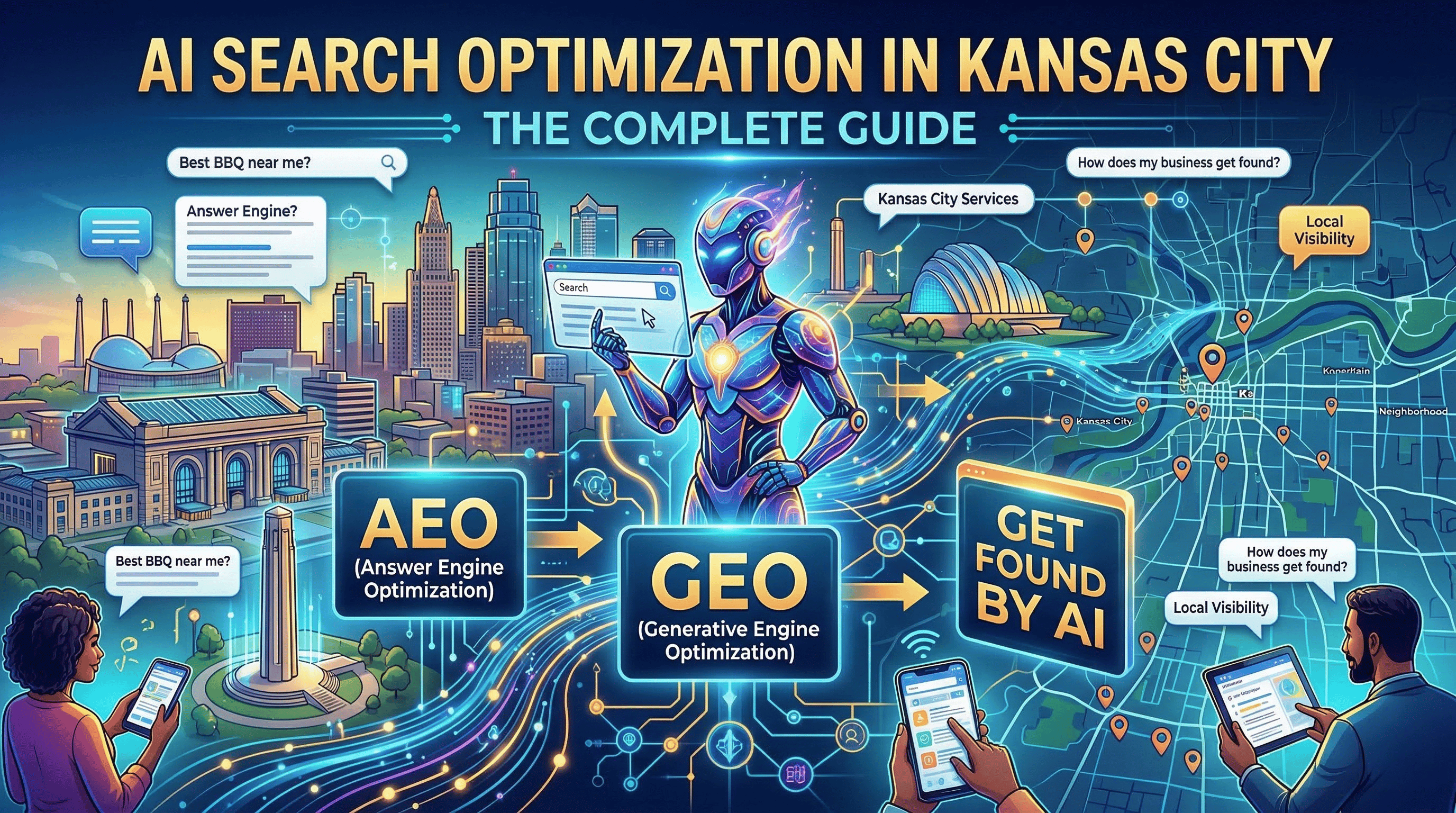
Quick Answer: What Does AI Search Optimization Cover?
AI search optimization for Kansas City businesses includes three interconnected disciplines:
- Answer Engine Optimization (AEO): Structuring content so AI assistants extract and recite your answers in response to direct questions, targeting voice search, featured snippets, and zero-click responses.
- Generative Engine Optimization (GEO): Earning citations and recommendations within AI-generated responses on platforms like ChatGPT, Perplexity, and Claude, where AI synthesizes multiple sources into a single answer.
- Technical AI Readiness: Implementing the underlying infrastructure, including semantic HTML, structured data, knowledge graph presence, WebMCP, and AI crawler access, that makes your content machine-readable across AI platforms.
Businesses that implement all three disciplines see an average 40% increase in AI mentions compared to their competitors who don't.
What Is Answer Engine Optimization (AEO)?
Answer Engine Optimization (AEO) is the process of formatting content specifically for AI assistants, voice search tools, and featured snippet systems to extract and deliver as a direct answer, without requiring the user to click through to your website.
AEO targets the moment before the click. When someone asks Siri, Alexa, Google Assistant, or a ChatGPT search query a direct question, such as "What's the best accounting firm in Overland Park?" or "How much does it cost to automate my business?", AEO determines whose answer gets read aloud or displayed as the top result.
Key AEO tactics include:
- Answer capsules: 50-150 word self-contained answers placed immediately after each heading, designed for direct AI extraction, with zero links inside the capsule text. Links inside the definition distract the AI parser; links placed after it validate it.
- FAQ sections with schema markup: Structured Q&A content that increases AI citation rates by 2.7x, compared to unstructured content, per Shahzad Safri's 2026 AI Citations Guide.
- Voice search optimization: Content written in natural, conversational language that matches how people speak queries, not just how they type them.
- Semantic cues: Phrases like "In summary," "The most important," "Step 1," and "Common mistake" embedded throughout content to help AI systems identify structural hierarchy and extract answers accurately.
AEO is particularly high-impact for local businesses as voice results almost always pull from structured, AEO-optimized content rather than standard web pages.
What Is Generative Engine Optimization (GEO)?
Generative Engine Optimization (GEO) is the discipline of making your business a trusted, citable source within AI-generated responses. These are the multi-paragraph, synthesized answers that ChatGPT, Perplexity, Claude, and Google AI Overviews generate when a user asks a complex question.
Where AEO captures the one-sentence answer, GEO earns the recommendation. When a Kansas City business owner asks Perplexity "What are the best Italian restaurants in Kansas City?", GEO determines whether your business is named, described, and linked within that generated response.
GEO operates differently from traditional SEO because AI platforms do not simply rank links. They synthesize information from multiple sources and present conclusions. To be included in that synthesis, your content must:
- Demonstrate topical authority across a consistent cluster of related topics.
- Provide original data and proprietary insights that AI systems can reference as primary sources.
- Earn citations from authoritative external sources that reinforce your credibility.
- Maintain content freshness: Perplexity AI shows higher citation rates for regularly updated content.
- Use structured formats including comparison lists, pros/cons breakdowns, and Q&A formats that AI platforms are built to parse and synthesize.
GEO is a longer play than AEO, but it delivers the highest-value outcome: being named as a recommended provider by AI systems that millions of users trust as their primary research tool.
AEO vs. GEO: What Is the Difference and Which Do You Need?
Both disciplines fall under the broader umbrella of AI search optimization, but they target different moments in the AI-assisted customer journey.
Answer Engine Optimization (AEO)
- Primary goal: Get your answer extracted and recited by AI assistants and voice search tools.
- Target platforms: Voice search, featured snippets, Google AI Overviews.
- Best content format: Answer capsules, FAQ schemas, direct definitions.
- Query type it targets: Direct questions such as "What is X?" and "How do I Y?".
- Timeline to results: 2-8 weeks depending on brand authority.
- Primary ranking signal: Content structure and schema markup.
- Traffic impact: Voice traffic, zero-click visibility, featured snippet appearances.
Generative Engine Optimization (GEO)
- Primary goal: Get your business cited and recommended inside AI-generated responses.
- Target platforms: ChatGPT, Perplexity, Claude, Gemini.
- Best content format: Original research, comparison content, topical authority clusters.
- Query type it targets: Complex queries such as "Best options for Z" and "Compare A vs B".
- Timeline to results: 2-6 months.
- Primary ranking signal: Domain authority, external citation patterns, topical depth.
- Traffic impact: Referral traffic from AI platforms, brand mentions, direct recommendations.
The most effective Kansas City AI search strategies combine both. AEO builds the structural foundation that makes your content extractable. GEO builds the authority and topical depth that earns you a named recommendation in AI-generated responses. Neither works optimally in isolation.
How Each AI Platform Selects and Cites Sources
Each major AI platform uses a distinct citation methodology. Understanding these differences is what separates platform-aware optimization from generic content improvements that produce inconsistent results.
ChatGPT
- Primary index: Bing plus pre-trained knowledge.
- Highest-impact factor: Authority signals and entity clarity. Brands consistently cited by reputable sources are prioritized.
- Update sensitivity: Moderate. Content should be refreshed every 30-60 days.
Perplexity AI
- Primary index: Live web retrieval on every query.
- Highest-impact factor: Recency, the highest-weighted factor of any platform. Content updated regularly sees meaningfully higher citation rates.
- Update sensitivity: High. Regular updates are essential for sustained citation presence.
Claude
- Primary index: Brave Search.
- Highest-impact factor: Helpfulness, factual accuracy, and Constitutional AI principles. Claude deprioritizes content with excessive promotion or unsupported claims.
- Update sensitivity: Moderate. Brave Search index refreshes independently from Google.
Google AI Overviews
- Primary index: Google Search plus Knowledge Graph.
- Highest-impact factor: E-E-A-T signals, page rendering speed, and Knowledge Graph entity presence. Sites in the top 10 organic results are 3x more likely to be cited.
- Update sensitivity: 2 weeks for established authoritative sites; up to 3 months for newer or smaller brands.
ChatGPT prioritizes brands consistently cited by reputable sources, content with clear entity signals, and original data framed as unique insights. Answer capsules of 50-150 words with minimal linking inside them are the strongest format signal.
Perplexity performs live retrieval for every single query, meaning recency carries more weight here than on any other platform. Content updated every 2-3 days sees meaningfully higher citation rates than static pages.
Claude uses the Brave Search index, which creates distinct source preferences, including stronger representation of privacy-conscious tech sites and independent publishers.
Google AI Overviews uses Retrieval-Augmented Generation (RAG) that dynamically pulls page passages at query time. Sites with strong traditional SEO foundations and Knowledge Graph entity presence are three times more likely to be cited than sites outside the top 20 organic results.
The Technical Foundation: What AI Systems Actually Need to Find You
The technical layer of AI search optimization determines whether AI platforms can discover, crawl, and trust your content in the first place, regardless of how well-written it is. Most Kansas City websites fail at this layer without knowing it.
Semantic HTML
Semantic HTML uses purpose-specific tags such as article, section, header, nav, and main, rather than generic div containers. AI crawlers including GPTBot, ClaudeBot, and PerplexityBot rely on semantic structure to understand what content is important, how it is organized, and what it is about.
A page built entirely with div tags looks like an undifferentiated wall of text to an AI system. A semantically structured page communicates hierarchy, context, and priority. Your content must also be fully accessible without JavaScript execution. Lightweight, fast-loading pages are prioritized in Google AI Overviews.
Structured Data and Schema Markup
Structured data is machine-readable metadata embedded in your page's code that explicitly tells AI systems what your content means, not just what it says. For Kansas City businesses targeting AI search visibility, the highest-priority schema types are:
Content schemas:
- FAQPage schema: Increases AI citation rates by 2.7x. (Research and Guide by Shahzad Safri)
- HowTo schema: Signals step-by-step instructional content to AI retrieval systems.
- Article schema: Communicates publication date, author, and publisher for credibility assessment.
Business schemas:
- LocalBusiness schema: Essential for appearing in AI-generated local search results on Claude and Perplexity.
- Organization schema: Establishes your brand entity across AI knowledge systems.
Knowledge Graph Architecture
The Google Knowledge Graph is a structured database of entities including people, businesses, places, and concepts that AI systems use as a trusted reference layer. Businesses with Knowledge Graph entries are prioritized in Google AI Overviews and Gemini responses because they represent verified entities rather than anonymous web pages.
Building Knowledge Graph presence requires consistent NAP (Name, Address, Phone) data across all online directories, a verified Google Business Profile, structured Organization schema on your website, and brand mentions from authoritative external sources. For Kansas City businesses, citations from the Greater Kansas City Chamber of Commerce and regional business publications contribute meaningfully to Knowledge Graph authority.
Knowledge Graph architecture is a distinct discipline. agenticplug.ai offers it as a dedicated service, mapping explicit relationships between your brand, products, experts, and services so AI agents can verify your authority and understand your business in full semantic context.
AI Crawler Access and llms.txt
AI platforms use dedicated crawlers to index content for their retrieval systems: GPTBot for ChatGPT, ClaudeBot for Claude, and PerplexityBot for Perplexity. Many Kansas City websites inadvertently block these bots through overly restrictive robots.txt configurations, making their content invisible to AI platforms regardless of content quality.
The emerging llms.txt standard provides AI systems with a structured roadmap of your most important content, explicitly signaling which pages should be prioritized for AI retrieval and synthesis.
WebMCP: The Next Frontier
WebMCP is a browser-native implementation of the Model Context Protocol, launched by Google Chrome in early preview on February 10, 2026. Where standard MCP requires server-side integration, WebMCP brings that same AI-to-business connectivity directly into the browser layer. This means AI agents running inside Chrome can query your business data, product catalog, and services without requiring a separate backend integration.
For Kansas City businesses, WebMCP represents the next step in AI search readiness: moving from being discovered by AI systems to being directly queryable by them. Businesses that implement WebMCP-compatible data structures now will be positioned ahead of the curve as browser-native AI agents become a mainstream discovery channel. Shahzad Safri covered the full WebMCP breakdown for agenticplug.ai in March 2026.
What Kills AI Citations (And What Most Kansas City Businesses Are Doing Wrong)
Understanding what prevents citations is as important as knowing what drives them. These factors actively make your content invisible to AI search bots, and most local businesses have at least one of them working against them right now.
- Paywalls and gated content: Requiring email signup or payment to view content is the fastest way to get de-indexed by AI bots like PerplexityBot and GPTBot. If AI crawlers cannot read it, they cannot cite it.
- Blocking AI bots in robots.txt: Disallowing GPTBot, ClaudeBot, or PerplexityBot in your robots.txt file eliminates any chance of citation on those platforms, even if your content is excellent.
- Aggressive pop-ups and interstitials: Modal windows and full-page consent walls that block content access signal poor user experience to AI crawlers and delay or prevent indexing entirely.
- Login requirements: Content behind authentication walls cannot be crawled or cited by any AI platform.
- Thin or duplicated content: AI platforms prioritize original sources. Aggregated, templated, or heavily repurposed content is consistently deprioritized in favor of primary sources.
- Outdated content with no freshness signals: Stale pages with no visible publication or update dates lose credibility, particularly on Perplexity where recency is the highest-weighted ranking factor.
- No named author or E-E-A-T signals: Anonymous content with no author info, credentials, or expertise signals is systematically ranked lower than content with clear human authority behind it.
If your Kansas City business website has any of these issues, they represent the highest-priority fixes before any content optimization work will have meaningful impact. Source: 2026 AI Citations Guide by Shahzad Safri
Why Kansas City Businesses Cannot Afford to Wait
The AI citation landscape in 2026 represents the same early-adopter opportunity that SEO represented in the early 2000s. Companies establishing citation authority now are positioning themselves before the space becomes saturated, and before competitors lock in the authority patterns that AI systems will default to for years.
The competitive implication for Kansas City businesses is concrete: AI platforms develop citation patterns based on which local businesses establish authority first. Early optimization creates a compounding advantage. Each AI mention generates additional brand signals that reinforce future citations. Businesses that delay are not simply missing traffic today; they are allowing competitors to establish the authority patterns that AI systems will rely on for years.
Kansas City's business landscape, from the professional services firms in the Crossroads District to the manufacturing corridors along the I-435 corridor, contains thousands of SMBs that have invested heavily in traditional SEO but have not yet addressed AI search readiness. That gap is the opportunity.
Why 360 Automation AI Is Kansas City's AI Search Optimization Leader
360 Automation AI began implementing AEO and GEO strategies for Kansas City businesses in early 2025, making it the first dedicated AI search optimization provider in the metro area. But what separates 360 Automation AI from agencies that have recently added "AI search" to their service pages is where its expertise actually comes from.
Founder Shahzad Safri also founded and leads agenticplug.ai, a nationally operating AEO, GEO, and Agentic Commerce Optimization company serving clients across New York, Texas, California, Florida, Illinois, Georgia, applying the same AI search methodology at national scale. 360 Automation AI is agenticplug.ai's technical implementation partner, meaning Kansas City businesses are not getting local-market experimentation. They are getting a nationally validated playbook, delivered locally.
The A.G.E.N.T.I.C. Methodology
agenticplug.ai's seven-phase methodology, Audit, Graph, Equip, Network, Track, Influence, and Convert, is the strategic backbone behind every 360 Automation AI AEO/GEO engagement. It is the same framework used to double clients' AI share of voice and beat local competitors on ChatGPT within three months, as documented in agenticplug.ai's client outcomes.
Nationally Published Thought Leadership
Shahzad Safri's 2026 Guide to AI Citations is actively used by practitioners across the industry, covering the platform-specific citation mechanics, content formats, and technical requirements that drive AI visibility. That depth of original research is the foundation of every client engagement.
AI-First, Not Adapted
360 Automation AI was built as an AI consultancy from day one, not a web design or traditional SEO firm adapting its messaging. The company's service portfolio spans Voice AI, Custom AI Agents, MCP Server implementations, Business Process Automation and AEO/GEO optimization, all as native AI services. That technical depth means AI search optimization is implemented alongside actual AI system architecture, not as a standalone content exercise.
Full Technical Stack
Unlike agencies offering content-only optimization, 360 Automation AI implements the complete technical layer, including semantic HTML, schema markup deployment, AI crawler access configuration, llms.txt implementation, Knowledge Graph optimization, MCP integrations, and WebMCP readiness assessments for businesses preparing for the next wave of AI-agent commerce.
Measurable Local Results
360 Automation AI's AEO/GEO implementations for Kansas City businesses have delivered an average 40% increase in AI platform mentions, based on client outcomes tracked across 2025 engagements.
Frequently Asked Questions About AI Search Optimization in Kansas City
What is the difference between SEO and AI search optimization?
Traditional SEO optimizes content to rank in Google's blue-link results by targeting keywords, building backlinks, and improving technical site performance. AI search optimization targets the AI-generated responses that now appear above those results, including structured summaries, voice answers, and named recommendations in platforms like ChatGPT, Perplexity, and Google AI Overviews.
How long does it take to see results from AEO and GEO?
AEO results, including featured snippet appearances and voice search citations, typically emerge within 2-8 weeks of proper implementation. GEO results, including named citations in ChatGPT and Perplexity responses, develop over 2-6 months as AI platforms accumulate authority signals and topical depth from your content. Building consistent citation presence generally requires 60-90 days of systematic optimization.
What is WebMCP and does my business need to prepare for it?
WebMCP is Google Chrome's browser-native implementation of the Model Context Protocol, launched in early preview on February 10, 2026. It enables AI agents running inside the browser to directly query business data without a server-side backend integration. For most Kansas City businesses, WebMCP readiness begins with ensuring your content and product data are structured in AI-parseable formats, the same foundation as AEO and GEO. Businesses starting now will be ahead of the curve when WebMCP reaches broad release.
Can I pay for AI citations the way I pay for Google Ads?
No. AI citations function as organic visibility, not paid placements. Platforms select citations based on content quality, authority signals, and relevance to user queries. There is no paid route to AI citation, which is precisely why businesses that build citation authority early create a compounding competitive advantage that cannot simply be purchased by a competitor later.
What AI platforms does 360 Automation AI optimize for?
360 Automation AI's AEO/GEO service optimizes for ChatGPT (OpenAI), Perplexity AI, Google AI Overviews, Claude (Anthropic), and Gemini (Google). Each platform uses different retrieval and citation mechanisms that require platform-specific optimization strategies.
Start Getting Found by AI in Kansas City
The most important next step is to systematically restructure your highest-value content for citation-based visibility across ChatGPT, Perplexity, Claude, and Google AI Overviews, using the universal factors: answer capsules, E-E-A-T signals, freshness indicators, and structural clarity.
360 Automation AI offers a complimentary 30-minute consultation to assess your current AI search visibility, identify the highest-impact implementation priorities for your business, and outline a realistic timeline to measurable results.
Contact 360 Automation AI: (816) 466-5846 | [email protected]
Led by MIT Sloan certified Shahzad Safri and serving SMBs across the KC metro since early 2025, 360 Automation AI is Kansas City's dedicated AI consultancy implementing AEO, GEO, Voice AI, Custom AI Agents, Business Process Automation, and MCP integrations for businesses competing in the AI-first economy.